Tier 1 · Prep
TO POUND
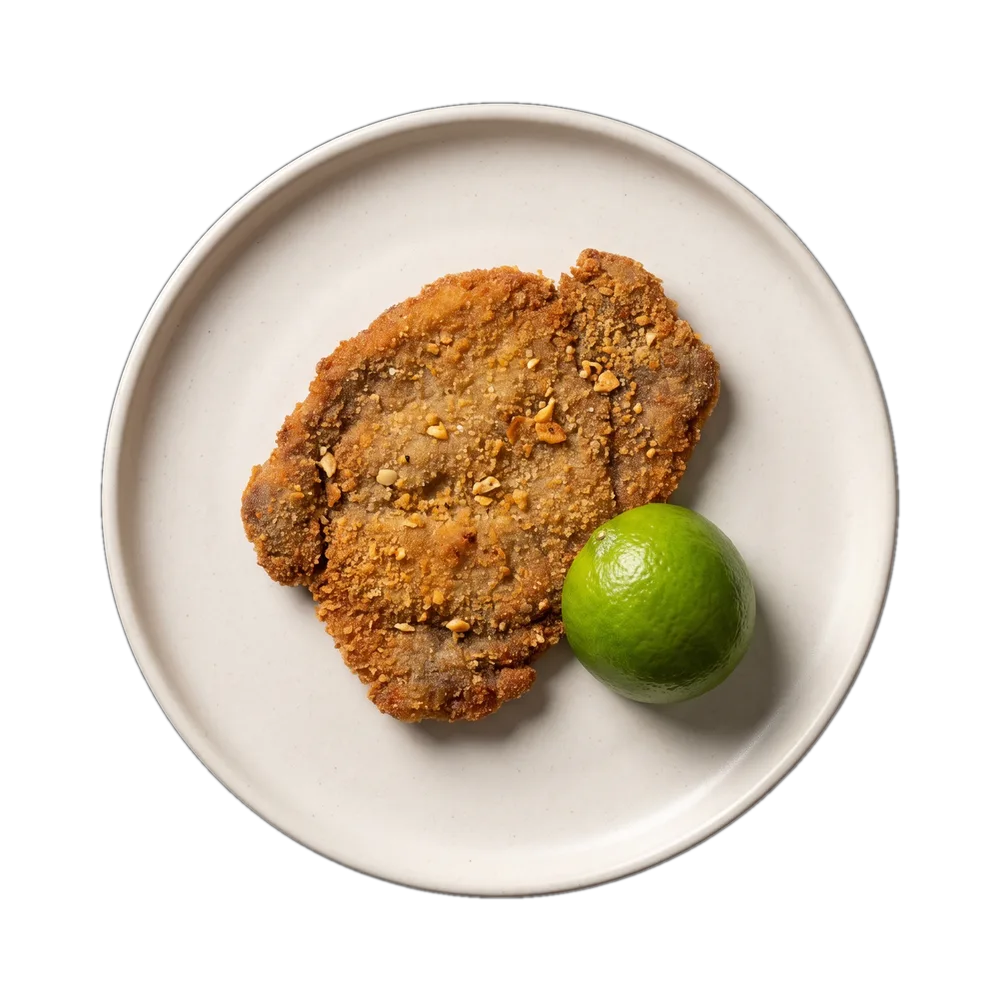
Flattening a piece of meat to one even thickness with a mallet or a heavy pan, so that it cooks through everywhere in the same time.
Why it works
Heat moves in from the surface, so a cutlet that is 2 cm at one end and 8 mm at the other is either raw at the thick end or dry at the thin one — there is no temperature that cooks both. Pounding fixes the geometry rather than the heat: a breast taken to an even 6 mm cooks in two or three minutes a side and can be rolled around a filling, as Chicken Kiev is. The blows also break some of the muscle fibres and connective tissue, which is why a pounded cutlet eats more tender than an unpounded one of the same cut. The force wants to be flat and spreading, not chopping — a flat mallet face or the base of a pan, through plastic or paper so the surface does not tear and shreds do not fly. Work from the centre outward; the middle is thickest and the edges are already thin.
How to tell
- Run a flat hand over the whole piece and feel no step — the thickness is the same at the centre as at the edge.
- Held up to the light there are no holes or thin windows; the meat has spread, not torn.
- The piece has grown to roughly twice its area and still lifts off the plastic in one sheet.
- For a filled roll like Kiev, the cutlet drapes and overlaps itself without cracking.
When it goes wrong
- Holes and ragged tears in the cutlet, shreds stuck to the mallet.
- Struck with an edge or a corner instead of a flat face, or with no plastic between — the blow chopped instead of spreading. Cover the meat and hit flat.
- One end is paper-thin while the middle is still thick.
- Started at the edges, which were thin to begin with. The first blows belong in the centre, working outward, with the fewest blows where the meat is already thin.
- The meat has gone mushy and pastes together when rolled.
- Over-pounded. Past even thickness every blow only breaks more fibres; stop the moment the thickness is uniform.
- Pounded to the right thickness but cooked unevenly anyway — the edges dried before the centre was done.
- The pan was crowded or too cool, so the cutlet steamed and took twice as long. A thin cutlet wants a hot pan and space around it — the pounding bought you speed, spend it.
Recovering it
A tear is patched, not thrown out: overlap the torn edges, chill for ten minutes so they hold, and bread the piece — the crust carries the seam. Too thin at one end is recoverable by folding that end under to double it before it goes in the pan. Mushy over-pounded meat is not recoverable as a cutlet; roll it tightly around a filling and cook it as a roulade, where the texture is hidden, and stop earlier next time.
Where to practice it
It carries to
Recipes using it
| Chicken Kiev | European | 80 |
| Chicken Marsala | European, American | 40 |
| Chicken Piccata | European, American | 35 |
| Chivito | Latin American & Caribbean | 30 |
| Grilled Chicken Breasts | American | 60 |
| Marry Me Chicken | American | 40 |
| Milanesa | Latin American & Caribbean | 40 |
| Torta de Milanesa | Latin American & Caribbean | 45 |
Generated from recipe step verbs and ingredient preparation forms. It is never authored, and it cannot drift from the recipes.