Tier 5 · Transform
TO CRIMP
Sealing the edge of a pastry by pressing or folding the two layers together into a ridge, so the filling stays in while it bakes.
Why it works
Two layers of dough fuse where they are pressed together with a little moisture between them — a brush of water or egg wash makes the surfaces tacky, and pressure thins the seam so it bakes through as one piece instead of two layers sitting on each other. The pattern is not decoration: a rope fold, a fork press or a pinched ridge is a mechanical lock that holds even when the filling boils and pushes outward. Because it does push outward — the filling gives off steam as it heats, and steam needs somewhere to go. A sealed pasty or pie without a vent bursts at its weakest point, which is always the seam, so a crimp comes with a small cut or hole in the top. A dry, floury edge will not fuse at all; too thick a rope bakes hard and pale; a wet filling touching the seam soaks it and it opens.
How to tell
- The edge is one continuous ridge; there is no line where the two layers meet.
- Lifted from the board, the sealed piece holds together with nothing shifting inside.
- The crimps are even along the whole edge, the same size and spacing.
- Out of the oven, the seam is golden and intact and any steam has come out of the vent, not the side.
When it goes wrong
- The seam opened in the oven and the filling ran out along the side.
- The edge was dry or floury so it never fused, or the pastry was overfilled and the filling reached the seam. Brush the edge, keep filling away from it, and press firmly.
- A burst at the top or a weak spot, with filling boiling out.
- No vent. Steam built up inside and found the weakest point. Cut a small slit in the top before baking.
- The crimped edge is pale, hard and thick while the rest is golden.
- Too much dough in the rope. A thick rope insulates itself. Trim the edge to a finger's width before crimping.
- The bottom near the seam is soggy and the edge came unstuck.
- Wet filling touched the seam, or the filled pastry sat too long before baking. Fill cold, seal at once, chill before the oven.
Recovering it
A seam that opens on the board is patched with a scrap of dough and a dab of water, then re-crimped. A gap noticed after brushing with egg wash is pressed shut through the wash — it will hold. Once it has opened in the oven the seal is gone; let it finish, scrape up what escaped and serve it, because the pasty inside is still cooked. A pale hard edge is trimmed away at the table and the rope made thinner next time.
Where to practice it
It carries to
Recipes using it
| Cornish Pasty | European | 100 |
| Jamaican Patty | Latin American & Caribbean | 95 |
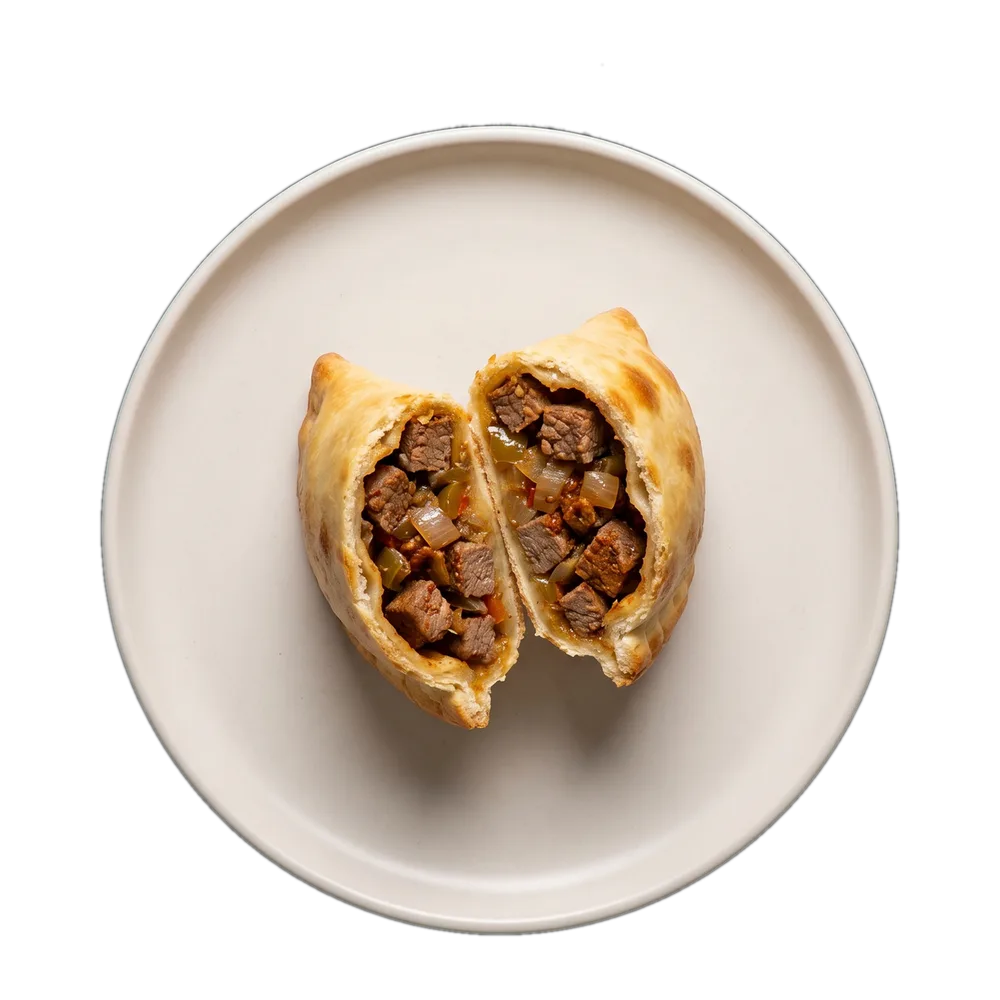
| Steak Empanada | Latin American & Caribbean | 95 |
Generated from recipe step verbs and ingredient preparation forms. It is never authored, and it cannot drift from the recipes.