Macarons
1410kcal7g protein54.1g fat230.8g carbs*Estimates computed from the ingredient list; cost uses average US supermarket prices. Not a substitute for packaging measurements or your receipt.
Contains dairy, egg, tree nut · sometimes contains soy — check the label
Restrictions
Containsdairy · egg · tree nutIt is in an ingredient you cannot leave out.
Sometimes contains — check the labelsoy (chocolate dark)Some brands have it, some do not. The recipe cannot tell, so this is the one you check yourself.
Diets
VegetarianPescatarianNo porkNo alcohol · check
Worked out from the ingredient list. It knows nothing about brands, shared equipment or cross contamination, and it is not a certification — if you have an allergy, you still have to read the label.
Ingredients
Servings:
| 100 g | egg whites (room temperature — weigh these first) |
| 130 g | almond flour, blanched and superfine (130% of the egg-white weight) |
| 130 g | powdered sugar (130% of the egg-white weight) |
| 100 g | granulated sugar, superfine if available (100% of the egg-white weight) |
| ¼ tsp | cream of tartar |
| 1 pinch | salt |
| 115 g | butter, unsalted and softened (for the buttercream filling) |
| 230 g | powdered sugar (for the buttercream filling) |
| 1 tsp | vanilla extract |
| 1 tbsp | heavy cream (to loosen the buttercream) |
Optional
Not counted above. The dish works without them.
| ¼ tsp | gel food colouring (never liquid colouring) |
| 120 g | dark chocolate (for a ganache filling instead of buttercream) |
| 120 g | heavy cream (for the ganache filling) |
| 15 g | cocoa powder (replacing 15 g of the almond flour for chocolate shells) |
| 100 g | raspberries (cooked down to a thick paste, folded into the buttercream) |
Steps
- weigh8 mindigital scale, bowl tared, whites separated one at a time into a cup firstegg whites, separated and weighed into a scrupulously grease-free bowl, and whatever number the scale reads is the anchor for everything that follows. Separate each white into a small cup before adding it to the bowl: one broken yolk contaminates the whole batch, because egg-yolk fat inserts itself between protein chains and stops them linking into a foam at all, and there is no rescuing it. Eggs are not a standard size, so 'three egg whites' is a range of roughly 85 to 115 grams — a 30 percent swing in the one ingredient every other quantity is measured against. That is the whole reason this recipe cannot be made from cups and spoons, and why the scale is equipment rather than a suggestion. Wipe the bowl and whisk with vinegar or lemon juice first if there is any doubt about grease; plastic bowls hold fat in their scratches and should not be used
- measure8 mineach quantity derived as a percentage of the weighed white, portioned into separate bowlsalmond flour and powdered sugar at 130 percent of the white weight each, granulated sugar at 100 percent, then cream of tartar and salt measured by spoon since they are too light for a household scale to read accurately. Work the arithmetic from the actual number on the scale rather than from the printed 100 g: 108 g of white means 140 g of almond flour and 140 g of powdered sugar, not 130. This is what keeps a partial or oversized egg from silently breaking the ratio, and the ratio is the entire recipe — too much dry mixture and the batter is stiff, will not spread flat and cracks in the oven; too little and it floods off the piping tip and bakes into thin discs with no feet. Portion each into its own bowl before starting, because macaronage runs on a clock once the meringue is up and there is no time to be weighing then
- prep12 minfine-mesh sieve, sifted together twice, lumps discarded not pushed throughalmond flour + powdered sugar, sifted together twice. Almond flour is ground nut and its own oil clumps it into small pellets; a pellet that survives into the batter becomes a bump on an otherwise glassy shell, and macaron shells are judged almost entirely on their surface. Discard anything that will not pass the sieve rather than forcing it through — forcing it presses oil out of the almonds, and free oil deflates meringue the same way yolk does. Pulsing the two together in a food processor before sifting gives a finer mixture, but pulse briefly: run it and you make almond butter. Sifting the two together rather than separately also premixes them, so the fold later takes fewer strokes
- whisk8 minmedium speed rising to medium-high; sugar added a spoonful at a timeegg whites + cream of tartar + salt, whipped to a loose foam, then granulated sugar rained in a spoonful at a time until the meringue is glossy and holds a peak that bends slightly at the tip. Add the sugar slowly and early-ish: sugar dissolved into the water phase makes the foam viscous and stable, but sugar dumped in at once weighs the foam down before it has built. The cream of tartar is an acid that lowers the pH and helps the proteins unfold and bond, which is why it buys forgiveness. Stop at firm-glossy rather than dry — one source explicitly warns against stiff peaks, and the reason is that an over-whipped meringue has already stretched its protein network to the limit, so it tears rather than flows during folding and gives lumpy batter that cannot be corrected. Gel colour goes in at the very end of whipping; liquid colouring adds water and will slacken the batter
- fold6 minspatula, two or three additions, judged by flow and not by countmeringue + the sifted dry mixture, folded by cutting down through the middle, sweeping around the bowl and pressing the batter briefly against the side to knock out large bubbles. This is macaronage and it is the step the dish is famous for, because you are deliberately deflating a foam you just spent eight minutes building — too little and the batter is stiff, holds the piping tip's peak and cracks in the oven; too much and it is soup that spreads into puddles with no feet. There is no fold count that works, only a flow test: the batter should fall off the spatula in a thick unbroken ribbon and sink back into the surface in about ten to twenty seconds, or let you draw a continuous figure eight without breaking. Test every few strokes once it starts loosening. Over-folded batter cannot be recovered by any means
- rest40 minpiped, rapped hard on the counter, then left uncovered at room temperaturepiped rounds, held perpendicular and about a centimetre above a lined sheet, then the whole tray rapped hard on the counter several times and left to dry until the tops are matte and a fingertip comes away clean. The rap forces the trapped air bubbles up and out — an unrapped shell erupts in the oven — and settles the peaks flat. The skin is the mechanism that makes a macaron a macaron: once the top has dried into a thin crust, expanding steam cannot escape upward, so it pushes out at the base instead and lifts the shell, which is the ruffled foot. No skin means no foot and a cracked top. Thirty to sixty minutes is typical and humid days can stretch it toward two hours, so go by the touch test rather than the clock. This step cannot be hurried with a fan or a warm oven without starting to cook the batter
- bake17 min300°F / 150°C, one tray at a time, rotated at 8 minutesrested shells, into a fully preheated oven for 15 to 17 minutes, until a shell lifts cleanly off the paper and its foot does not wobble when the top is nudged. The published temperatures across tested sources run from 270°F to 325°F paired with correspondingly longer or shorter bakes, and 300°F sits in the middle — but home ovens vary more than that spread does, so use an oven thermometer and judge by release and set feet rather than by the number. Bake one tray at a time: two trays block airflow and give the lower one a pale, hollow, footless shell. Underbaked shells stick to the paper and tear their bottoms out when lifted, so if one resists, give the tray another two minutes rather than persevering. Cool completely on the sheet before touching them
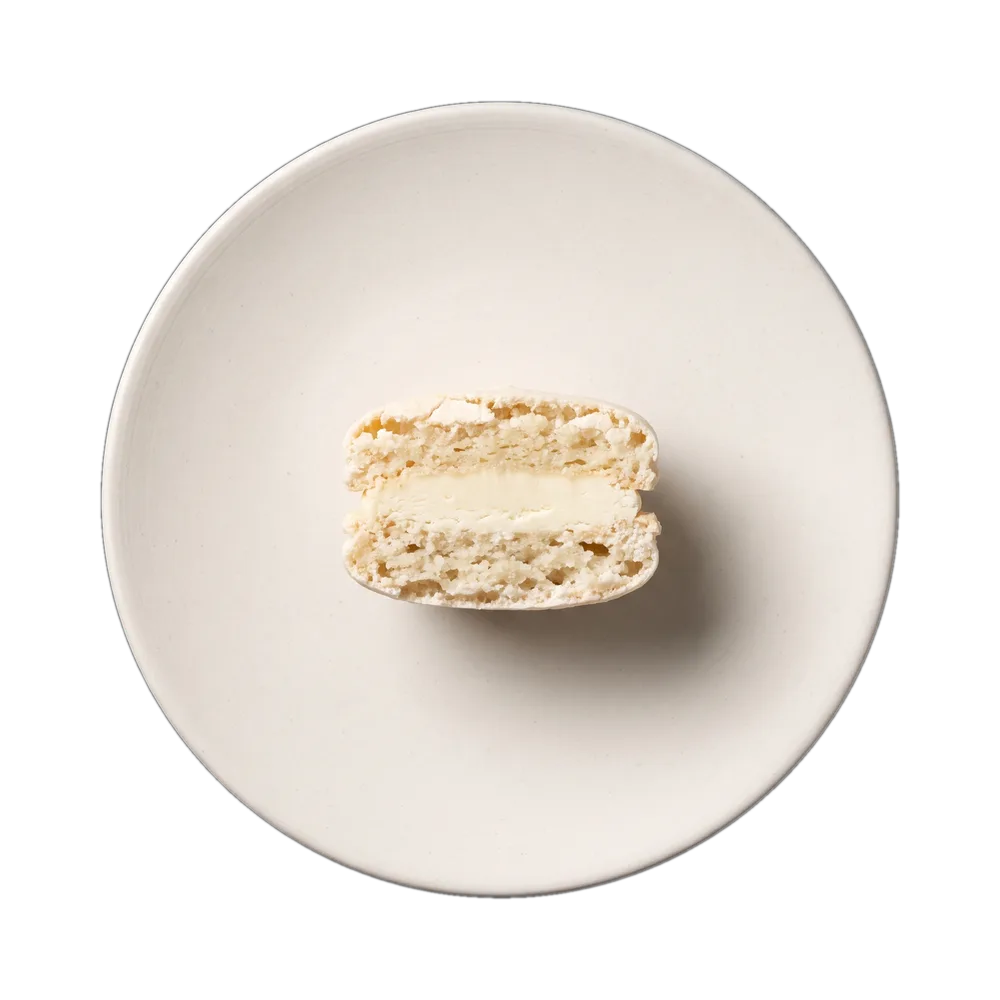
- mix12 minbutter beaten pale first, then sugar in two additionssoftened butter, beaten until pale and aerated, + powdered sugar in two additions + vanilla + salt + cream to loosen, then piped onto half the shells and topped with their partners, matched by size. Beat the butter properly before the sugar goes in — buttercream mixed all at once is grainy, and the graininess never disperses. Keep the filling firm enough to hold: a loose filling weeps into the shell within an hour and turns the crisp interior soggy. Ganache is the more stable alternative for filled macarons that must travel, since set chocolate holds the sandwich together rather than lubricating it
- store10 minairtight, refrigerated 24 hours, brought to room temperature before servingfilled macarons, sealed in an airtight box and left in the refrigerator for a full day before they are eaten. This maturation is a real step and not patience for its own sake: moisture migrates out of the filling into the shell, softening the interior into the slightly chewy texture a macaron is supposed to have while the outside stays crisp. A macaron eaten an hour after assembly is a dry meringue disc with icing between the halves. They keep about five days refrigerated and freeze well filled; bring them back to room temperature before serving, because cold butter filling tastes of nothing