Jibarito
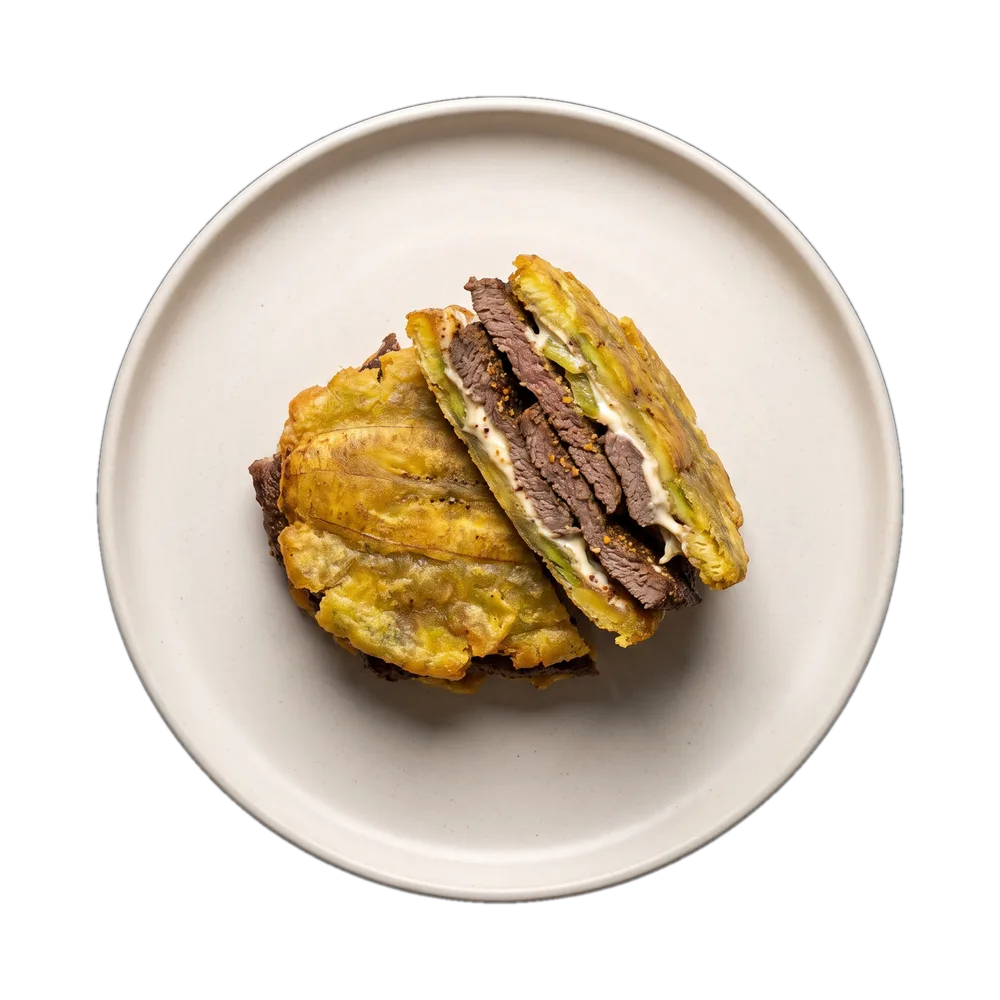
1436kcal29.9g protein91.5g fat145.8g carbs*Estimates computed from the ingredient list; cost uses average US supermarket prices. Not a substitute for packaging measurements or your receipt.
Contains dairy, egg · sometimes contains gluten, soy — check the label
Restrictions
Containsdairy · eggIt is in an ingredient you cannot leave out.
Sometimes contains — check the labelgluten (adobo seasoning, sazon) · soy (Mayonnaise)Some brands have it, some do not. The recipe cannot tell, so this is the one you check yourself.
Diets
No pork · without oneNo alcohol
Worked out from the ingredient list. It knows nothing about brands, shared equipment or cross contamination, and it is not a certification — if you have an allergy, you still have to read the label.
Ingredients
Servings:
| 4 unit | green plantains (hard, dark green, no yellow) |
| 4 cup | neutral frying oil (at least 1 inch deep) |
| 4 cup | water (salted, for soaking the cut plantains) |
| 1 lb | skirt or flank steak (trimmed) |
| 2 tsp | adobo seasoning |
| 1 tsp | sazón |
| 1 tsp | garlic powder |
| ½ tsp | black pepper (ground) |
| 1 tsp | salt |
| ¼ cup | mayonnaise |
| 2 tbsp | ketchup |
| 1 clove | garlic (finely grated, into the sauce) |
| 4 slice | Swiss cheese (sliced) |
| 4 unit | lettuce (whole leaves) |
| 1 unit | tomato (sliced thin) |
| 1 unit | onion (sliced paper-thin) |
Optional
Not counted above. The dish works without them.
| 1 tsp | hot sauce (in a garlic-mayonnaise sauce instead of mayo-ketchup) |
| 4 slice | American cheese (in place of Swiss) |
| 2 tbsp | olive oil (raw garlic oil brushed on the top plank) |
| 1 ½ tsp | red wine vinegar (in a steak marinade) |
| 1 lb | chicken (thigh, in place of steak) |
| 4 slice | ham (sliced, in place of steak) |
Steps
- prep8 minknife, not fingers; then soaked in salted watergreen plantains, ends cut off, the skin scored lengthwise in three or four lines cutting right through to the flesh, then the peel prised away in strips with a thumb or the back of the knife. Plantain skin is thick, dry and bonded to the fruit — it does not slip off like a banana's, and trying to pull it will shred the plank you need whole. Cut each into two crosswise then split lengthwise for large flat planks, and hold them in salted water while you work: it stops the cut surfaces oxidising grey and it seasons the starch through rather than only on the outside, which is the difference between a plank that tastes of something and one that tastes of nothing. Pat completely dry before they go near oil
- fry12 min350°F, in loads, 5 to 7 minutes a side, no browningplantain planks, lowered into moderate oil and cooked until they are soft enough that a fork slides in with no resistance and they are still pale ivory. This fry cooks the starch through and nothing else. Colour here is a failure, not progress: a plank browned on the first fry has already used up its surface, so the second fry has nowhere left to go and you end up with something hard and dark instead of crisp. Drain on a rack rather than paper, which traps steam under them and softens what you just cooked
- mash5 minpressed between two plates or in a tostonera, while hotdrained planks, flattened in one firm, even push to between an eighth and a quarter inch. Pressing while hot works because the cooked starch is still plastic; a cooled plank cracks and falls apart instead of spreading. Thinner is crisper and more fragile, thicker is sturdier and chewier — a quarter inch is the safer choice for a sandwich that has to hold steak and sauce. Press straight down, once: rocking or repeated squeezing tears the plank along its fibres and gives you a hinge that will break at the first bite
- fry5 min375°F, 1 to 3 minutes a side, salted straight out of the oilflattened planks, back into hotter oil until deep gold and rigid, then lifted onto a rack and salted immediately while the surface is still slick and hot. This fry does one job: it drives the remaining surface moisture off and sets a crust. Salt applied now dissolves into the film of hot oil and sticks; salt applied to a cooled plank slides straight off onto the plate. The oil must be hotter than the first fry — the same temperature twice gives you a greasy plank, because it is the temperature difference that flashes the surface water away instead of letting it soak
- sear8 minripping-hot cast iron or grill, 4 to 5 minutes a sidesteak + adobo + sazón + garlic powder + black pepper rubbed in, laid on a surface hot enough to hiss loudly on contact and left alone. Skirt and flank are thin and lean, so the only way to get a crust before the middle is grey is heat you would consider excessive on a thicker cut. Sazón is what gives the meat its characteristic orange cast — that is annatto, not chilli, and it is colour and mild savour rather than heat
- rest8 minon a board, loosely tented, off the heatthe steak, left alone before a knife touches it. Cutting straight off the heat lets the juice run out onto the board instead of redistributing through the muscle, and in a sandwich built on a crisp starch plank that juice has somewhere very unwelcome to go. A rested steak also carves cleanly where a hot one drags
- slice3 minagainst the grain, on a slight bias, thinrested steak, cut across the visible fibres. Skirt and flank have long, coarse muscle fibres running one obvious direction, and slicing with them leaves strands that will pull the whole filling out of the sandwich in one bite. Thin slices also lie flat, which matters here — a lumpy filling levers the top plank off
- mix2 minwhisked smoothmayonnaise + ketchup + grated garlic = mayo-ketchup, the standard Puerto Rican condiment, at roughly two to four parts mayonnaise to one of ketchup. Grate the garlic rather than chopping it so it disperses instead of ambushing one bite. A garlic mayonnaise cut with hot sauce is the named alternative and does the same structural job, which is to seal the inner face of the bottom plank against the wet filling above it
- top4 minassembled hot, eaten immediatelybottom plank + mayo-ketchup spread to the edges + Swiss cheese laid on while the plank is hot enough to soften it + sliced steak + lettuce + tomato + onion + the second plank, pressed gently. Build these one at a time as the planks come out of the fryer. The plank is a crisp shell holding a small amount of moisture at bay, and it starts losing that fight the moment it cools — a jibarito assembled and left five minutes is a good sandwich on limp plantain. Cut it corner to corner with a serrated knife and a sawing motion; pressing down with a straight blade shatters the plank