Dill Pickles
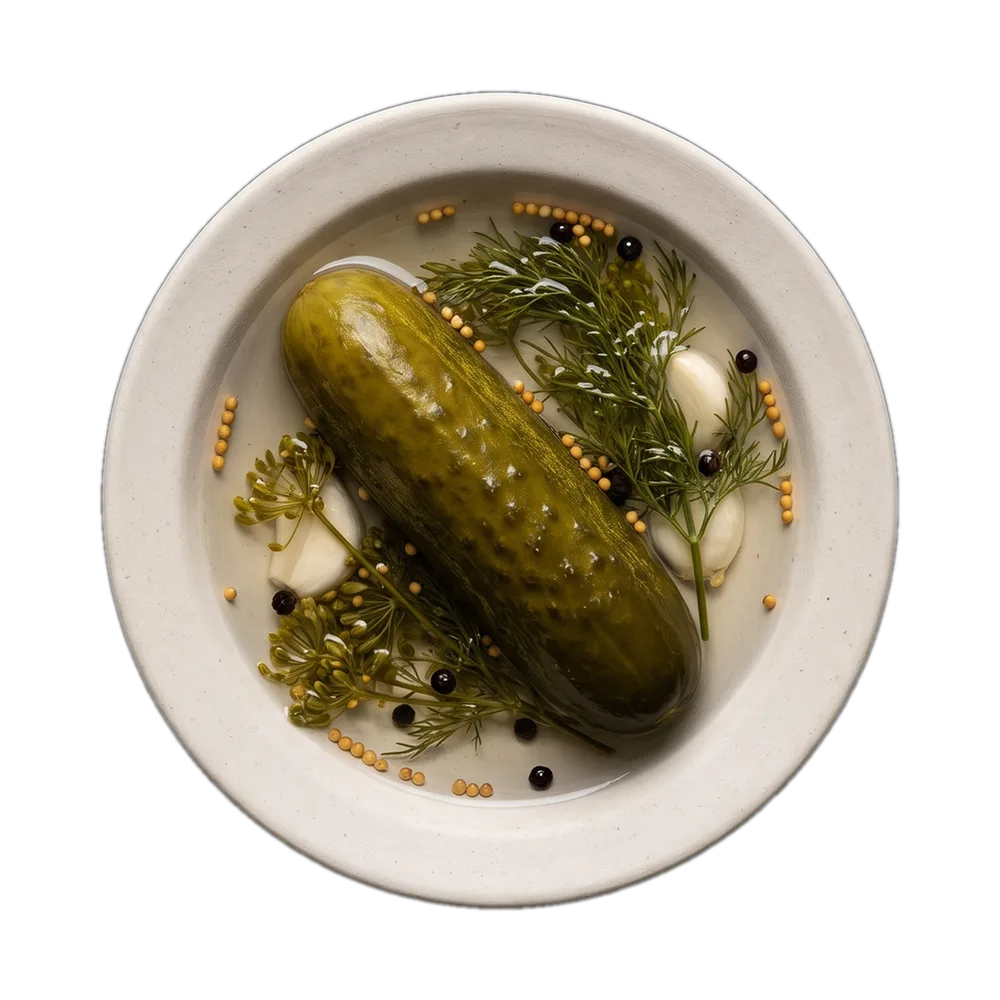
252kcal7.7g protein1.1g fat43.3g carbs*Estimates computed from the ingredient list; cost uses average US supermarket prices. Not a substitute for packaging measurements or your receipt.
Nothing flagged in the ingredient list. The label is still the last word.
Restrictions
Diets
VegetarianVeganPescatarianNo porkNo alcohol
Worked out from the ingredient list. It knows nothing about brands, shared equipment or cross contamination, and it is not a certification — if you have an allergy, you still have to read the label.
Ingredients
Servings:
| 4 lb | pickling cucumbers, about 4 inches, picked within 24 hours |
| 4 cup | white distilled vinegar, 5% acidity |
| 4 cup | water |
| ½ cup | pickling or canning salt (no iodine, no anti-caking agents) |
| 12 unit | dill, fresh heads (1 to 1.5 per pint) or 1 tsp dill seed per pint |
| 12 clove | garlic (peeled, lightly smashed; 1 to 2 per pint) |
| 4 tsp | yellow mustard seed (1/2 tsp per pint) |
| 1 tsp | black peppercorns (4 per pint) |
Optional
Not counted above. The dish works without them.
| ¼ cup | sugar (softens the vinegar's edge; does not affect safety) |
| 4 tsp | coriander seed (1/2 tsp per pint) |
| 1 tsp | calcium chloride crisping salt (1/8 tsp per pint) |
| 8 unit | grape or oak leaf (1 per jar, for tannin) |
| 2 tsp | red pepper flakes (1/4 tsp per pint) |
Steps
- slice20 mincold running water, blossom end only, a 1/16-inch coincucumbers, scrubbed clean and a thin slice cut from the blossom end of each — the end opposite the stem scar, which is slightly pointed and often carries a dried blossom remnant. This is not trimming for looks. An enzyme concentrated in the blossom end breaks down pectin, and left in the jar it will soften every pickle around it over the following weeks; a whole batch can go limp from this alone. Buy or pick cucumbers no more than a day old and use them the same day. No later step recovers crispness — the canner, the calcium chloride and the tannin leaf all only slow a decline that starts the moment the cucumber leaves the vine
- prep15 minjars washed hot and held hot; lids warmed, not boiledpint jars, washed and kept hot in the canner water, with dill heads, garlic, mustard seed and peppercorns dropped into the bottom of each. Hot jars matter mechanically: boiling brine poured into a cold jar can crack it, and a jar that starts cold takes longer to reach processing temperature than the published time allows for. Sterilizing the jars in advance is unnecessary for anything processed ten minutes or more, because the process itself sterilizes the contents. Aromatics go in first so the cucumbers can be packed on top of them without floating them up into the headspace
- brine10 minnon-reactive pot, brought to a full boil, salt fully dissolvedvinegar + water + pickling salt (+ sugar if using), boiled together until clear. The ratio is the recipe: 5% acidity vinegar in roughly equal volume with water gives a finished product acidic enough that Clostridium botulinum cannot grow, which is the entire reason a jar of vegetables can sit on a shelf. Reducing the vinegar to soften the flavour, topping up with extra water, or substituting a vinegar of unstated strength removes that protection and there is no visible sign when it has been removed. Use canning or pickling salt only — table salt carries iodine and anti-caking agents that cloud the brine and can darken the pickles — and never add flour, cornstarch or any thickener, which insulates the centre of the jar and stops heat reaching it
- pickle20 minpacked tight, 1/2 inch headspace, rims wiped, rings finger-tightcucumbers packed upright and tight into the hot jars, then boiling brine poured over to leave exactly half an inch of headspace above the liquid. Tight packing keeps the cucumbers under the brine; anything that floats above the acid is not preserved, whatever the rest of the jar is doing. Run a plastic tool down the inside to release trapped air bubbles, then wipe every rim with a clean damp cloth — one seed or smear of brine on the rim is enough to prevent a seal, and an unsealed jar is a refrigerator pickle whether you meant it to be or not. Tighten the ring to fingertip pressure only. The lid has to vent during processing; a ring cranked down traps expanding air, buckles the lid and gives a false seal
- can15 minboiling-water canner, jars covered by 1 inch, 10 minutes for pints at sea levelfilled jars, lowered onto the canner rack into water already at a full boil and covered by at least an inch, timed from the moment the water returns to a rolling boil. The process does three things at once: it drives residual air out of the headspace so the cooling jar pulls a vacuum and seals, it kills spoilage yeasts and moulds that the acid alone would not, and it destroys the softening enzymes. Ten minutes for pints, 15 for quarts, at sea level. Above 1,000 feet water boils below 212°F, so the same ten minutes delivers less heat — use 15 minutes above 1,000 feet and 20 above 6,000. A cook at 5,000 feet who follows the sea-level number has an under-processed jar that looks identical to a good one. Bubbles escaping from under the rings during the boil are normal and expected
- store10 minundisturbed 12 to 24 hours, then seal-checked; cured 2 to 4 weeks in the darkjars lifted straight up without tilting onto a towel, spaced apart, and left completely alone for 12 to 24 hours — moving or pressing a lid while the vacuum is still forming breaks the seal that is in the middle of setting. Then remove the rings and test each lid: it should be concave and immovable, and lifting the jar by the lid alone should hold. Any jar that flexes goes in the refrigerator and is eaten within weeks; do not re-process it and do not shelve it. Store sealed jars without their rings in a cool dark place, where they keep about a year, and wait two to four weeks before opening the first one. The brine has to penetrate the whole cucumber, and a jar opened the next day tastes of raw cucumber in vinegar and gets judged a failure it has not had time to avoid